
Plane Heads
How you can simplify the human face into flat surfaces
Art teachers have proposed various schemes for simplifying the head into an arrangement of flat planes. Here are two plane breakdowns by Andrew Loomis, author of Figure Drawing for All It’s Worth and Drawing the Head and Hands.
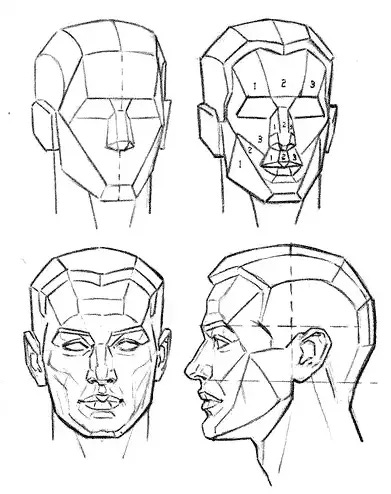
The pair of drawings at the top represent a simple breakdown, with front, side, and bottom planes. The two below subdivide the planes further. To be precise, some of these “planes” aren’t true planes in the geometric sense, (such as the curving surfaces on the top of the cranium).
Fred Fixler, a student of famed Art Students League instructor Frank Reilly, came up with a slightly different plane breakdown for an idealized male head. There are some rounded forms too. The cranium is seen as a ball with the sides sliced off.
Sculpting the plane head brings this analysis into the realm of reality. This one is by painter and teacher John Asaro (born 1937), who has a website called “Planes of the Head.” He has taught head painting using his plane head.
Many academic instructors have used plane heads as models before going to the live human, because it’s much easier to accurately judge the values and color notes of each plane, compared to the infinitely variegated tones and curving forms of a real face.
Drawing and painting from plane heads is a central part of Chinese and Russian academic practice, and various companies have offered art school maquettes, such as this simplified head.
This mini plaster head (above) is very different from a European or American standard head, and the planes are broken down into a mosaic of small forms. But the ear is treated as a single plane.
People will debate the merits of these commercially available heads, but I’ve never been completely satisfied with any of them. I think it’s a great exercise for any student to come up with their own analysis, and that’s what I did when I was in art school.
Before I knew about Sculpey, I made this the hard way, sculpting a plastilina original, and then making a two-piece mold and casting it in plaster. Mine was inspired mainly by Loomis and George Bridgman.
I have set up my little plane head and painted him in colored light.
Once you’ve practiced drawing and painting from idealized plane heads, and even sculpting your own breakdowns, the next step is to look at real human models and break the planes down in a unique way for that individual model.
This was the method taught in a seminar I took from instructor Paul Souza, and here’s an exercise I did in that class, scumbling white oil paint over chip board sealed with shellac.
In truth, there is no single ideal plane head, and even an individual model’s face can be analyzed in various ways.
If you’re interested in playing with a little AI, you can have Google’s Nano Banana generate a plane analysis for you.
Here’s how you do it: upload a photo of yourself (using the little plus sign in the prompt box) along with a sample plane breakdown that you want the result to resemble, and paste in this prompt:
Please create a new image from the uploaded one, eliminating the surface coloration of the head, hair, and clothing, and simplifying the facial structure into a planar analysis, rendered in black lines on white paper, similar to the uploaded sample by a mid-20th century illustrator. Remove glasses and don’t add hair or otherwise try to flatter me.
It did an OK job (it couldn’t resist adding the hair). But to my eye it gives the superficial semblance of a plane breakdown without really delivering what you would get if you actually sculpted it with your own hands.
If you can improve the prompt, please let me know in the comments. And if you’ve tried sculpting a physical plane head—or have painted a study from one—tell me about your experience.


Please don’t use NanoBanana— I’d like to say don’t use any genAI at all, but SPECIALLY NanoBanana— Google has been using their cloud technology on Israel’s apartheid and the data you would be giving it to “play around” is free data that actively harms Palestinians :(
We recently learned how to use the 3d printer at our library! I would love to print a plane model bust to draw from!